Table Of Content

The text above the railing feels supported by the railing; however, it’s also visually balanced by the image of the boy on the right. The column in the image is slightly off center, and it anchors the composition with a strong vertical line — it’s an object we know weighs a lot. The railing on the left provides a strong connection with the left edge of the screen.
Balanced Incomplete Block Design (BIBD)
The iPhones are placed equally on the screen while the text on top is on even lengths on both sides. Reflection symmetry is where one half of the image reflects the other half. All of these are equally important, but as you can notice, the first on the list is balance, proving its significance. This article will focus on balance in design and give examples that you can get inspiration from.
Warm colors in a creative space
The home page of Vlog.it exhibits radial balance, which I hope is clear from the screenshot. Other than the shape in the top-right corner, everything revolves around the center of the page, as the three rings of images rotate around the center circle. I think moving these two elements out of center to make them look like they’re visually centered would balance the composition a little better.

What is an example of balance in the principles of design?
Our team of writers have over 40 years of experience in the fields of Machine Learning, AI and Statistics. Or suppose we want to perform a two-way ANOVA to determine if different combinations of fertilizer and sunlight cause the same mean growth in plants. Now, any edge of the \(λK_v\) must appear in some \(K_k\) (the one coloured with the colour of that edge). In each of these, there are \(k−1\) points besides \(p\).
Timeline Hops, Soul Family & Emerging from the Dark Night of the Soul
This movie poster for Sherlock Holmes is a perfect example of symmetrical balance. This type of balance places elements in an even and orderly fashion. The ones on this poster are evenly divided into both sides, creating what is commonly known as formal balance.
But there are six color combinations to avoid that you might currently be considering, and so the designers below have suggested alternatives that will work so much better. 'Rather than compliment each other, I find they tend to fight,' says the interior designer Alexandra Kaehler, of when room color ideas go wrong. She suggests looking for shades that have the same undertone as that will create a natural sense of harmony, and allow you to play with colors a little more bravely. There are times when we look at a design and think something’s off, but we can’t put our finger on it. So for your designs to be effective, make sure that it has balance.
Examples Of Symmetrical Balance
In this section I’ll talk about how to analyse data from balanced designs, since this is the simplest case. The story for unbalanced designs is quite tedious, so we’ll put it to one side for the moment. It refers to the distribution and visual weight of elements in a composition. A well-balanced design is naturally pleasing to the eye and exudes a sense of equilibrium. It is the careful distribution of visual weight in your website design, logos, blog images, and many other design assets.
Fine Print: Melinda Cox's Balanced Design - Boston magazine
Fine Print: Melinda Cox's Balanced Design.
Posted: Tue, 22 Nov 2016 08:00:00 GMT [source]
How do Unbalanced Designs Occur?
Considering their relative size, a basketball and a bowling ball appear to weigh the same. We know that the physical weight of a bowling ball is much heavier than a basketball. There’s a bit of chaos and randomness in the different-sized blocks, some denser than others. Because the stories on the website change daily, a different chaos will appear each day. The smaller circle in the upper right adds a little translation symmetry and some asymmetry, increasing visual interest in the composition. There’s a sense of translation symmetry as the gold lines of text repeat in the upper left and lower right of the image, as well as in the button further down the page.
Since the first three columns contain some pairs more than once, let's try columns 1, 2, and now we need a third...how about the fourth column. If you look at all possible combinations in each row, each treatment pair occurs only one time. I have a Master of Science degree in Applied Statistics and I’ve worked on machine learning algorithms for professional businesses in both healthcare and retail. I’m passionate about statistics, machine learning, and data visualization and I created Statology to be a resource for both students and teachers alike. My goal with this site is to help you learn statistics through using simple terms, plenty of real-world examples, and helpful illustrations.
First, there are \(b\) blocks, each of which has \(k\) points in it. A uniform design is a design in which every block contains the same number of points, \(k\). Careful perusal of this scheme will show that every pair of treatments is used together on precisely one of the mice.
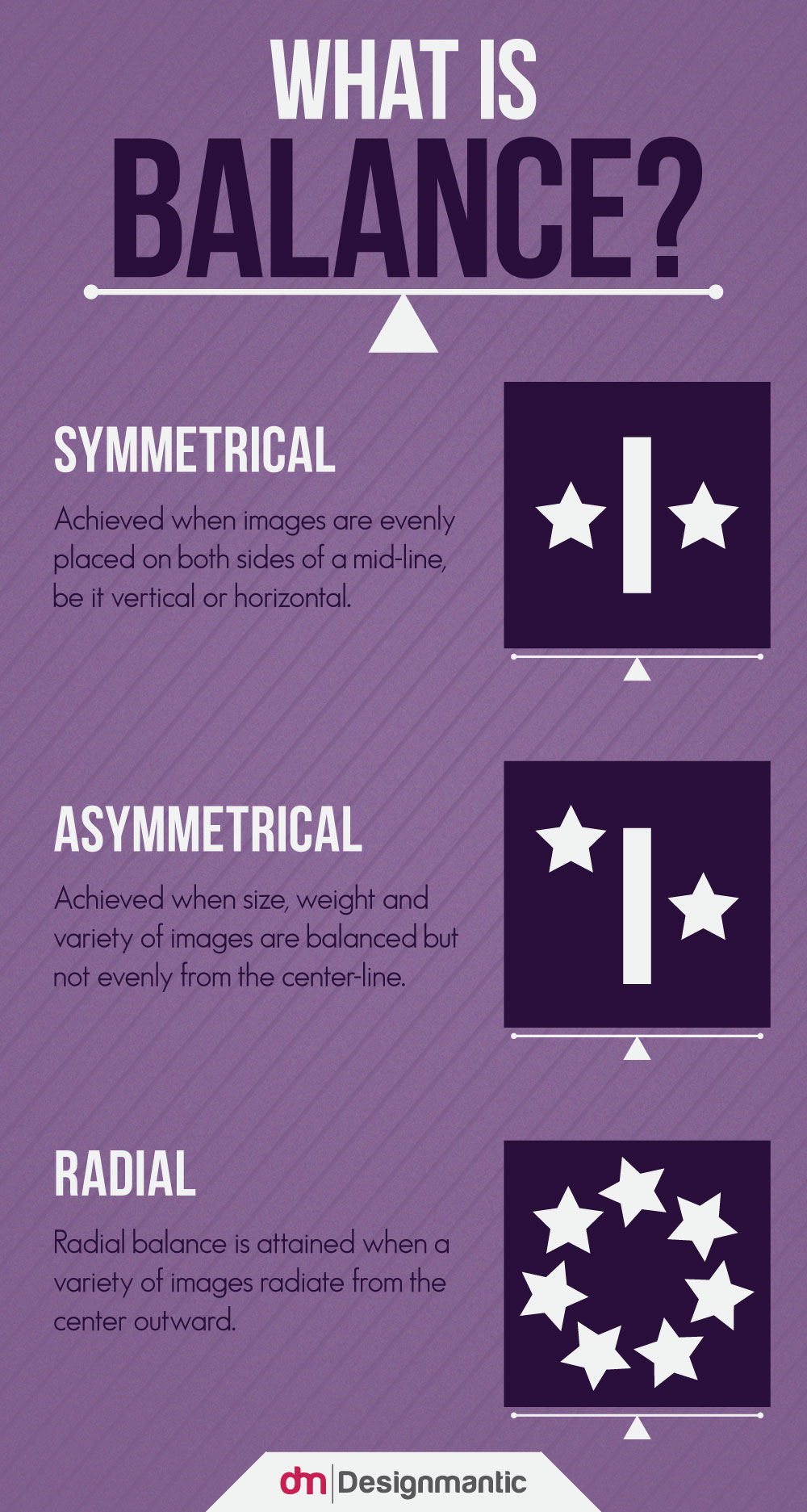
The columns have different amounts of text, for example. As I’ve reiterated throughout the series, what follows is my opinion. Thinking critically about the designs is more important than our agreeing about what we think. I have a few more websites than usual for this last article in the series, and I’ve grouped them according to the four types of balance. Reflection symmetry (or bilateral symmetry) occurs when everything is mirrored around a central axis. It’s probably the first thing you think of when you hear the word “symmetry.” The axis can be in any direction or orientation, although it’s often vertical or horizontal.
Some designs with radial balance are clock faces, sunbursts, and mandalas. On this list, you’ll see it in the British Petroleum logo. Balance in design can be achieved in different ways, one is to use shape or form.
And if you’re an agency that needs white label graphic design, we’ve got you covered too. If we were to explain this in simpler terms, we’d say that asymmetrical balance is almost like multiple smaller elements on one side, balancing one big element on the other. While this is not actually perfectly balanced, our eyes treats it as if it is.
This subset of columns from the whole Latin Square creates a BIBD. In general, we are faced with a situation where the number of treatments is specified, and the block size, or number of experimental units per block (k) is given. This is usually a constraint given from the experimental situation. This type of test is much more robust to unequal sample sizes and unequal variances across treatment combinations. If the sample sizes across treatment combinations are not equal, but the assumption of equal variances is met, you can still proceed to perform an ANOVA anyway.




No comments:
Post a Comment